Tuesday, 9 October 2012

Famous Australians


Famous Australian actors

A number of Australian actors have found international success, including the Academy-winning Geoffrey Rush, star of Shineand the King and I. Russell Crowe, Nicole Kidman and Cate Blanchett have also claimed the Best Actor honour. Action hero Hugh Jackman is also a Tony Award-winning singer and dancer. Other famous Australian actors include Naomi Watts, whose cut-through role was in Mulholland Drive, and Heath Ledger, who won a posthumous Oscar for his performance in The Dark Knight. Australian actors of international fame include Guy Pearce, Eric Bana, Tony Collette, Rachel Griffiths and Paul Hogan. Errol Flynn was famous for romantic swashbuckling roles in the 1930s and 1940s.

Famous Australian sportspeople

Sport is a huge part of Australian culture and the nation has produced many sporting greats. Our cricketing heroes include Sir Donald Bradman, Ritchie Benaud, Allan Border, the Waugh brothers, Shane Warne and Glen McGrath.  Famous Australian swimmers include Dawn Fraser, Shane Gould, Kieren Perkins and Ian Thorpe. Our most famous runner is Cathy Freeman, who lit the Olympic flame and claimed gold in the 400m at the 2000 Sydney Olympics. Other lauded runners include Betty Cuthbert, Herb Elliot and John Landy, famous for his sportsmanship at the 1956 Melbourne Olympics. Australian tennis stars include Rod Laver, Ken Rosewall, John Newcombe, Pat Cash, Pat Rafter, Lleyton Hewitt, Margaret Court and Evonne Goolagong Cawley.

Famous Australian singers and songwriters

There are famous Australian singers across every musical genre. Our greatest opera singers were Dame Nellie Melba and Dame Joan Sutherland. Australian country music stars have included Smoky Dawson and Slim Dusty, and more recently John Williamson, James Blundell, Kasey Chambers, and Keith Urban. Pop princess Kylie Minogue hit the international charts many years after Grease star Olivia Newton John and icon John Farnham. Jimmy Barnes, Peter Garret, Michael Hutchence and Daniel Johns claimed fame as lead singers in rock bands. Famous Aboriginal singers include Jimmy Little, Christine Anu, Archie Roach, Ruby Hunter and Geoffrey Gurrumul. Rolf Harris has written many iconic Australian songs while songwriter and entertainer Peter Allen has been immortalized in a stage musical.

Famous Australian artists

Our famous Australian artists include the late avant-garde painter Brett Whitely, landscape painter John Olson and photographers Bill Henson and Tracey Moffat. Ken Done has also won worldwide fame for his colourful paintings and designs. Famous Aboriginal artists of the last century include Albert Namatjira, David Malangi, Rover Thomas, Queenie McKenzie and Emily Kngwarreye.  Painters Florence Rodway, Grace Cossington Smith and Margaret Preston were at the vanguard of the modernist movement, while painter Norman Lindsay attracted controversy for his nudes. Other famous Australian artists have included painter Pro Hart, modernist photographer Max Dupain, Heidelberg painters such as Tom Roberts and Arthur Streeton and surrealists Sidney Nolan, Arthur Boyd and Albert Tucker.

Famous Australian writers

Famous Australian writers include Bryce Courtenay, our top-selling novelist, and Colleen McCullough. Patrick White won the 1973 Nobel Prize for literature and the Man Booker Prize has been awarded to Thomas Keneally, Peter Carey (twice) and DBC Pierre. Other acclaimed contemporary writers include David Malouf, Tim Winton, Kate Grenville, Helen Garner, Christopher Koch, playwright David Williamson and Geraldine Brooks, who won the 2006 Pulitzer Prize for Fiction. Australia’s notable expatriate writers include Clive James, Robert Hughes, Geoffrey Robertson and feminist writer Germaine Greer. Important names in Australia’s literary history include the bush poets Henry Lawson and Banjo Paterson and novelists Henry Handel Richardson, Miles Franklin, Christina Stead and Marcus Clarke.

Famous Australian politicians

Sir Henry Parkes was the earliest advocate for federal government. Edmund Barton was Australia’s first Prime Minister, followed by Alfred Deakin, who presided over three governments. Billy Hughes, Australia’s seventh Prime Minister, changed parties five times over his 51-year parliamentary career.  Robert Menzies was the country’s twelfth and longest-serving Prime Minister and founder of the Australian Liberal Party. Early Labor Prime Ministers include John Curtin, who led Australia through World War II, and Ben Chifley, who established Australian citizenship. Gough Whitlam is remembered for his progressive reforms and dramatic dismissal. Australia’s more recent prime ministers include Malcolm Fraser, Bob Hawke, Paul Keating, John Howard, Kevin Rudd and Julia Gillard.

Famous Australians scientists

Pharmacologist and pathologist Howard Florey shared a Nobel Prize in 1945 for his work extracting penicillin. Other Australian scientists who are Nobel Laureates include William Bragg, John Warcup Cornforth, John Eccles, Bernard Katz, Peter Doherty and Elizabeth Blackburn. Geologist Dorothy Hill was the first female professor in an Australian university. Other famous Australian scientists include immunology and virology pioneer Frank Macfarlane Burnet, magnetism specialist Robert Street, theoretical chemist David Craig and climate change expert Tim Flannery.  Brian Anderson, Richard Stanton and Patricia Woolley have also made significant contributions in their various fields.

Famous Australian inventors and famous Australian inventions

Australia’s Aboriginal people invented the aerodynamic boomerang and a spear thrower called the woomera. Famous Australian inventors include Alfred Traeger, who built a radio for the Royal Flying Doctor Service in 1929, and David Ronald de Mey Warren, who invented the flight data recorder and cockpit voice recorder. Professor Ian Frazer 2006, Australian of the Year, invented a vaccine to prevent cervical cancer. Other famous Australian inventions include notepads (1902), the surf lifesaving reel (1906), aspirin (1915), the pacemaker (1926), penicillin (1940) the Hills Hoist clothesline (1946), the plastic disposable syringe (1949), the wine cask (1965), the bionic ear (1978), dual-flush toilet flush (1980)anti-counterfeiting technology for banknotes (1992) and long-wearing contact lenses (1999).

Famous Australian explorers

Following Captain Cook’s 1770 landing, and the arrival of the First Fleet in 1788 a number of early explorers set out to discover Australia. These included the duos Bass and Flinders, who charted Tasmania, the ill-fated Burke and Wils, and Hume and Hovel, who walked from Sydney to the Victorian coastline. Ernest Giles trekked through Australia’s harsh western deserts on camelback and George Evans discovered the Lachlan River Valley region of central New South Wales. Other early famous Australian explorers include Thomas Mitchell and John Oxley.  In the 20th century Sir Douglas Mawson led a series of important scientific expeditions to Antarctica.

Other famous people of Australia

Australia’s famous people include cardiac surgeon Victor Chang, who pioneered an artificial heart valve and ophthalmologist Fred Hollows who helped to restore eyesight in more than a million people across the world. Famous Australian businesspeople include media mogul Rupert Murdoch and the late Robert Holmes a Court, Kerry Packer and Richard Pratt. Famous Australian film directors include Bruce Beresford, Baz Lurhmann, Jocelyn Moorhouse, Phillip Noyce, Fred Schepsi and Peter Weir. Famous Australian engineers include John Bradfield and Sir John Monash. Ben Hall and folk hero Ned Kelly were both famous Australian bushrangers. Other famous Australians include aviator Charles Kingsford-Smith, performer Barry Humphries and social reformer Eddie Mabo.

Australian Culture: Symbols

The Southern Cross
Southern Cross
The Southern Cross is one of the most visible constellations in the Southern Hemisphere and right from the early days of the colony, it was being used to represent Australia. Perhaps the colonists identified with the Christian connotations, and the idea that god was somehow watching over Australia. Perhaps they identified with the four moral virtues of the Southern Cross, justice, prudence, temperance and fortitude, as defined by Dante. Perhaps they identified with the idea of a clear night sky, which was a distinguishing environmental characteristic when compared to Britain’s grey night skies.
The Southern Cross is used on the Australian flag and is commonly used as a symbolic tattoo by Skippies (Australians of British descent.)

The Eureka Flag

Eureka Flag Symbol
The Eureka Flag was arguably Australia’s first patriotic symbol. It was designed by a Canadian Digger Lieutenant Ross during the Eureka uprising in Ballarat, Victoria, in 1854. The flag's five stars represent the Southern Cross. The white cross joining the stars represents unity in defiance. The blue background represents the blue shirts worn by the diggers.

As the flag was raised, one of the rebellion's leaders, Peter Lalor, got down on one knee, pointed his hand towards it and said,
'WE SWEAR BY THE SOUTHERN CROSS TO STAND TRULY BY EACH OTHER, AND FIGHT TO DEFEND OUR RIGHTS AND LIBERTIES.'
500 onlookers then said amen with their hands stretched towards the flag. The rebellion ended in a massacre, which was followed by a host of concessions to the rebels. Peter Lalor became a politician and betrayed his former comrades.
Over the following 150 years, the flag was used as a symbol to rally activists around various causes. Miners and shearers used it in their strikes in the 1890s. The Australian Communist Party called its youth wing the Eureka Youth League. Maoists adopted the flag, as did the National Front.
The use of the flag alienated conservatives, who were typically loyal to Britain. Today, the flag is used by left-wingers who base their identity on union membership and left-wingers who base their identity on race. Conservatives still don't like it.


Ned Kelly's Helmet

In 1880, bushranger Ned Kelly led his gang into a shoot out clad in iron suits. His legs were shot out from beneath him, he was captured, tried and hung. Despite being a criminal, something about his iron suit resonated with the general population. Some have argued that it represented a hero, a victim, a man who armoured himself against Australia, faced it, conquered it, and lost. In a way, it represented an individual armouring himself against persecution, which naturally appealed to a population in which the elitist class were pure British citizens proud of their British culture.
Kelly's armour has been incorporated into paintings, advertisements, business logos and is arguably Australia's most proliferated symbol.


The Australian Flag

Australian Flag
The Australian Flag was chosen after a competition in 1901. The competition guidelines stipulated that a Union Jack must be included. Symbolically, the location in the top left-hand corner signals servitude to Britain. The Southern Cross was included to represent Australia. The seven-pointed Commonwealth Star was located beneath the Union Jack to represent Australia's federal system.
The presence of the Union Jack has made the flag controversial and unable to be the uniting symbol that a flag should be.  Some Australians support the retention of the Union Jack as an acknowledgement of Australian history. Some Australians want the Union Jack replaced with the Aboriginal flag as an acknowledgment of Australian history. Some Australians just don’t want a flag that signals servitude to any other social group.

The Wattle

Green and Gold
Many of the colonists identified with Australian flowers, much like the English identified with roses, the Scottish with thistles and the Irish with shamrocks. Because of its unique colours and design, the wattle became associated with Australia. In 1912, it was included as decoration surrounding the Commonwealth Coat of Arms. In the 1920s, the green and gold colours of the wattle became associated with Australian sport.  

The Slouch Hat

Slouch Hat
Since its inception more than a century ago, the slouch hat has become one of the most distinctive and defining items of Australian clothing. It is made with rabbit-fur or wool felt and has one side of the brim pinned to the side. It has been suggested the pinning made it easier to sling a rifle over the soldier. While that may have been the case, other countries never felt the need to pin one side of their hats to the side in order to sling a rifle over the shoulder. Although the need to sling a rifle over a shoulder was definately not unique to Australia, no other countries decided to have their soldiers wearing the hat in such a way.
Perhaps the Australian soldiers pinned the hat because they put pragmatism over style. Alternatively, military commanders mght have encouraged the hat to be pinned because it distinguished Australian soldiers from other soldiers in British allied forces. This distinguishment helped build a unique social identity of the Australian soldiers, which was good for morale.
In addition to the pinning, the slouch hat gained uniqueness via the addition of native bird feathers. Emu plumes were often added for decoration or to again signal some kind of Australian characteristic.

Simpson and his Donkey

Simpson and His Donkey

During the 24 days he spent at ANZAC cove, John Simpson operated as a sole unit with his beloved donkey/s and is credited with saving the lives of hundreds of men.
 Simpson would start his day as early as 6.30 a.m. and often continue until as late as 3.00 a.m. He made the one and a half mile trip, through sniper fire and shrapnel, 12-15 times a day. He would leave his donkey under cover whilst he went forward to collect the injured. On the return journey he would bring water for the wounded. He never hesitated or stopped even under the most furious shrapnel fire and was frequently warned of the dangers ahead but invariably replied "my troubles".
  After seeming to gain an aura of someone with divine protection, Simpson was killed. He was recommended for the Victoria Cross, twice, and the Distinguished Conduct Medal but his larrikin behaviour did not endeared him to the authorities. He was never decorated for his actions.
Simpson's image was seen to embody the ANZAC spirit of abandonment of everything except that which is important. In 1965, to commemorate the 50th anniversary of the ANZAC landings, Australian stamps where issued depicting Simpson, his donkey and a wounded soldier. In 1967, the Australian Government released the ANZAC Commemorative Medallion. It depicted Simpson and his donkey. In 1995, the Australian five dollar commemorative coin was released. Again, it depicted Simpson, his donkey and a wounded soldier. In 1996, the Australian 100 dollar bill was released. It had Simpson and his donkey in the background.

Coat of Arms

Coat of Arms
The Commonwealth Coat of Arms may have been inspired by the Bowman Flag designed in John and Honor Bowman of Richmond NSW in 1806. The Bowman Flag put a Kangaroo and Emu aside a shield containing an English Rose, a Scottish thistle and an Irish shamrock. Below was the motto, "England expects that every man will do his duty"
In 1886, an unofficial Coat of Arms was designed for the New Atlas Australia. A Kangaroo and Emu looked curiously at a shield depicting the Eureka Southern Cross and four aspects of Australian industry at that time; mining, wool, wheat and tall ships.
In 1912, King George V granted the current Coat of Arms but the symbols of industry were replaced with symbols of the six Australian colonies; a Magpie for South Australia, a Black Swan for Western Australia, a Maltese Cross and Crown for Queensland, a Lion for Tasmania, the Southern Cross for Victoria and the lion and stars representing New South Wales. Beneath the Arms are sprays of golden wattle, Australia's official national floral emblem.
An oral tradition developed that the Kangaroo and Emu were included because they can’t walk backwards thus symbolising the Australian trait of looking to the future.  
The Coat of Arms has been used for embellishing the Australian passport, on the back of coins, to stamp something as a Commonwealth initiative, on the uniform of the international representative team of Australian football and has been adapted to make the logo used on the the ‘baggy green’ cricket cap. Arguably, it is the most widely accepted symbol in Australia.


Dot painting

Dot Paiting
Dot painting has been used to symbolise Aboriginal culture, and to a minor extent, Australian culture in general. The dot patterns are used on souvenirs, uniforms of Qantas staff, and wine bottles. The style developed in the 1970s when a white school teacher north of Alice Springs, Geoffrey Bardon, encouraged children to paint a mural using traditional body and sand painting techniques. Using acrylics, the children created a new style of painting.  
Complete acceptance of dot painting as a symbol of Australia has been complicated by a number of issues. Firstly, the stye is seen more as representative of Aborigines that all Australians. Even using it to define Aborigines is problematic. Because the style evolved froma traditional art form that was used in only one region of Australia, and which was not used by other Aboriginal tribes around Australia, it is not a true reflection of all Aborigines. Using it to define Aborigines as a whole is a bit like using the English rose to define Europeans.
Admittedly, culture usually has its genesis in one small area and subsequently spreads out over a wider area. The dot pattern could do the same. There are plenty of Aborigines with no traditional association with dot painting that now use the dots in their art. Potentially, non-Aborigines could also assimilate the style. The incorporation of the dot pattern into a number of different designs indicates that there are many non-Aborigines that want to use the pattern to define themselves. Additionally, the genesis of the style was an example of cultural fusion.
Unfortunately for the identity wishes of non-Aboriginal people, many Aborigines want to monopolise it as an Aboriginal-only symbol and many non-Aborigines want to ensure that Aboriginal culture and Australian culture are not one and the same.

Boxing Kangaroo Flag

Boxing Kangaroo
In 1983, the yacht Australia II ended the Americans 132 year dominance of the America's cup. However it was the manner of the victory rather than the prize itself that inspired the nation. The yacht's 'winged keel' reflected Australian innovative thinking whilst the very fact that they dared challenged American supremacy typified the Australian underdog's sense of self belief. 
In subsequent celebrations, wealthy and common Australians cheered side by side, typifying the egalitarian ethic that every democratic society tries to promote.
The Boxing Kangaroo was the marketing icon of this victory and like the yacht race, it struck a chord with the Australian public. 
There have been calls for the boxing kangaroo flag to replace the official flag but critics say it is not sombre enough and associates Australia too closely with sport. 


Boomerang

The boomerang was a unique hunting tool, weapon and ritualised implement used by Aboriginal tribes. The curved wings allowed the boomerang to fly, with the spin producing lift much like a helicopter. If moulded in such a way, it could be made to come back.

The boomerang shape is used in logos, and boomerangs are sold in souvenir stores.  The appeal of the boomerang could be its recognisability as Australian, its ingenuity, or the idea of something coming back. It is one of the few Aboriginal-origin symbols that can be used freely in non-Aboriginal society without accusations of cultural theft or politicising.  


VB

VB
The VB logo is quite an unusual symbol to be used to express patriotism. Even though other cultures love beer, none would wear beer t-shirts to signal which country they come from, or wave beer cartoons in preference to their national flag.
The popularity of VB as a national symbol probably goes the classic VB commercials that incorporated environmental imagery of Australia with a variety of Australian professions to create a strong Australian image. This image seemed more have more emotional resonance than that conveyed by symbols such as the national flag.


Vegemite


Vegemite is a bread spread that is made from expired beer yeast. Although the recipe is unique, it is similar to the English spread Marmite in taste.  
As well as being sold in supermarkets, Vegemite is sold in souvenir stores and many Australian travellers back a jar of vegemite when they head abroad. The link between Australian travelling and Vegemite was popularised in the 1984 song, Downunder, which carried the lines:
“Buying bread from a man in brussels


He was six foot four and full of muscles
I said, do you speak-a my language? 
He just smiled and gave me a vegemite sandwich”

Perhaps the appeal of Vegemite can be attributed to the fact that most foreigners hate it. Many foreigners think it looks, smells and tastes like faeces. World rejection has helped Vegemite become something that can help define Australians as unique.


The Sydney Opera House

Opera House
The Opera House has frequently been used in advertising campaigns and business logos to symbolise both Sydney and Australia.  Despite being a popular symbol, it has never been clear as to what it actually symbolises. It certainly doesn’t symbolise that Australians love Opera because the vast majority do not. The late billionaire Kerry Packer articulated how many Australians feel about  opera when he said,
“The ultimate purgatory for me would be to go to the Opera House and hear Joan Sutherland sing.”
Despite not liking Opera, Australians probably like the Opera House because it seems to represent a water and beach culture. The Opera House’s design looks a bit like shells on a beach or sails on the water.


Uluru

Uluru rises from Australia’s flat desert centre. Because the outback has traditionally had a central role in the Australian identity, the rock has been used as a symbolic heart of the outback.
Uluru 

The Rainbow Serpent

Rainbow Serpent
The rainbow serpent was a mythological figure in many Aboriginal cultures. The Aborigines told of a great snake that emerged from beneath the earth, winding from side to side, making the great rivers flow from its path. From its body sprang the tribes, the animals and the birds of Australia. It was spoken upon in a hushed voice for it inflicted vengeance upon those who angered it. Stories told of it swallowing people who had not observed taboos. Contrary to myth, it was not the universal creation spirit. Some cultures told of a dingo that created the world.
Today, the rainbow serpent has been incorporated into artwork that symbolises the interconnectivity of Aboriginal cultures with the environment.


Opal

Opals
The opal has all the characteristics to become a national symbol. Australia produces 96% of the world’s commercial opal and it is a gemstone that matches almost all items clothing.
In 1993, it was named Australia’s official gemstone. Despite being beautiful, officially sanctioned and unique to Australia, it is rare to see Australians wearing opal jewellery. Instead, most opal is exported or sold through souvenir shops. In some ways, Opal is the Fosters of the gem world.

The informal cartoon character

A very common depiction of the Australian man is an informal looking cartoon character with a smile. Often the character is adorned with Australian inventions such as a cork hat or a stubby holder. The depiction is often seen on souvenir t-shirts, stubby holders and on internet sites trying to portray a fair dinkum Aussie feel.
Although the image makes some Australians cringe, it probably represents Australian male culture better than any other symbol. As much as it pains some Australians to admit, Australian men have an informal, inventive, laid back and from a self-depreciating culture that generally puts lifestyle above show. They are not exponents of high fashion, refinement, and elegance.  While there are some Australians that want the men to be fashionable, refined and elegant, at present, most Australians do not. Things may change in the future, but until they do, the cartoon character is really quite a good representation of the Australian male's approach to life.
Although the cartoon character is a good symbol for Australian men, there isn’t a positive female equivalent. Unlike the men, Australian women are pressured to be refined. Whereas there is status for a millionaire male to speak with the same broad Australian accent as a tradesman, or to dress as a tradesman, the same does not hold true for women. If a woman spoke with an Australian accent, she would be seen as masculine or trashy. (This is reflected in Australian English, which is the only English dialect to have a gender difference in pronunciation.) Because women must be more refined, the informal cartoon character tend to be more negative.


The male "bloke" stereotype is actually quite positive and there is some status associated with it. The female "sheila" stereotype; however, is quite negative.


Aussie BlokeAussie Sheila

Monday, 8 October 2012

Australia: Geert Hofstede with definitions!


Exploring the Australian culture through the lens of the 5-D Model gives a good overview of the deep drivers of Australian culture relative to other world cultures.


Power distance

This dimension deals with the fact that all individuals in societies are not equal – it expresses the attitude of the culture towards these inequalities amongst us. Power distance is defined as:
"the extent to which the less powerful members of institutions and organisations within a country expect and accept that power is distributed unequally."
It has to do with the fact that a society’s inequality is endorsed by the followers as much as by the leaders.  
  • Australia scores low on this dimension.
  • Within Australian organizations, hierarchy is established for convenience, superiors are always accessible and managers rely on individual employees and teams for their expertise. 
  • Both managers and employees expect to be consulted and information is shared frequently. 
  • At the same time, communication is informal, direct and participative.  

Individualism

The fundamental issue addressed by this dimension is: 
"the degree of interdependence a society maintains among its members."

It has to do with whether people´s self-image is defined in terms of “I” or “We”. In Individualist societies people are supposed to look after themselves and their direct family only. In Collectivist societies people belong to ‘in groups’ that take care of them in exchange for loyalty.


  • Australia, with a score of 90 on this dimension, is a highly individualistic culture.
  • People look after themselves and their immediate families.
  • In the business world, employees are expected to be self-reliant and display initiative.
  • Also, within the exchange-based world of work, hiring and promotion decisions are based on merit or evidence of what one has done or can do.


Masculinity / Femininity

A high score (masculine) on this dimension indicates that the society will be driven by competition, achievement and success, with success being defined by the “winner” or “best-in-the-field.” This value system starts in school and continues throughout one’s life – both in work and leisure pursuits.
A low score (feminine) on the dimension means that the dominant values in society are caring for others and quality of life. A feminine society is one where quality of life is the sign of success and standing out from the crowd is not admirable.
The fundamental issue here is what motivates people, wanting to be the best (masculine) or liking what you do (feminine).

  • Australia scores 61 on this dimension and is considered a “masculine” society.
  • Behaviour in school, work, and play are based on the shared values that people should “strive to be the best they can be” and that “the winner takes all”.
  • Australians are proud of their successes and achievements in life, and it offers a basis for hiring and promotion decisions in the workplace.
  • Conflicts are resolved at the individual level and the goal is to win.

Uncertainty avoidance    

The dimension Uncertainty Avoidance has to do with the way that a society deals with the fact that the future can never be known: should we try to control the future or just let it happen? This ambiguity brings with it anxiety and different cultures have learnt to deal with this anxiety in different ways.
The extent to which the members of a culture feel threatened by ambiguous or unknown situations and have created beliefs and institutions that try to avoid these
is reflected in the UAI score.
  • Australia scores 51 on this dimension and is a fairly pragmatic culture in terms of uncertainty avoidance
  • Both generalists and experts are needed.
  • There is focus on planning, and they can be altered at short notice and improvisations made.
  • Emotions are not shown much in Australia, people are fairly relaxed and not adverse to taking risks.
  • Consequently, there is a larger degree of acceptance for new ideas, innovative products and a willingness to try something new or different, whether it pertains to technology, business practices, or foodstuffs.  

Long-term orientation

The long term orientation dimension is closely related to the teachings of Confucius and can be interpreted as dealing with society’s search for virtue,
the extent to which a society shows a pragmatic future-oriented perspective rather than a conventional historical short-term point of view.


  • Australia scores 31 on this dimension and is a short-term oriented culture.
  • It is a culture focused on traditions and fulfilling social obligations.
  • Australian businesses measure their performance on a short-term basis, with profit and loss statements being issued on a quarterly basis.
  • This drives individuals to strive for quick results within the work place.
  • There is also a need to have the “absolute truth” in all matters.

Thursday, 6 September 2012

Escape Pod


A small Japanese engineering company, Cosmo Power, have designed an escape pod, otherwise known as 'Noahs Arc', that holds up to four adults and floats on water. The concept of this design is fantastic as I can't think of any other device that would be effective in saving lives in a tsunami, typhoon or earthquake, all natural disasters which unfortunately are high risk for some parts of the world.

'Noah's Arc' pod

The capsule, made of “enhanced fiberglass”, measures four feet in diameter, can hold up to four adults. It features watertight doors, air vents, and integrated water ballast (to keep it floating upright). 


Analysing the design of this fibreglass pod, it looks incredibly cramped and uncomfortable conditions if it were to be holding it's maximum capacity of four adults. They appear to have paid little attention to interior safety features. There appear to be no safety belts or webbing and little, if any, padding. It seems occupants are expected to hang on to the vertical bar while being tossed, which hardly seems practical! I figured a device which is similarly as effective, but better designed, would be fantastic for citizens who lived in high risk tsunami, earthquake and typhoon areas.
Most of the coastal countries in Asia face high risk of tsunamis and so do the countries on the western coast of the American continents. Tsunami threat is also eminent in the seismologically active Mediterranean Sea. About 90 per cent of the world's earthquakes occur along the Pacific Ring of Fire, a belt that covers almost all of Asia and Americas' Pacific coast.
India and its neighbouring countries also face a high degree of threat from tsunamis, as shown in the map below.

Tsunami threat zones


Costing £2,498 for the entry level pod, it is clear that the target market would be families living in the developed areas of Asia and America.

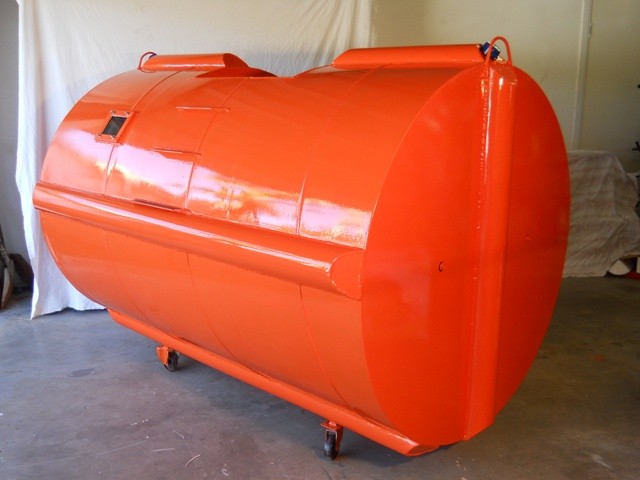
I researched into more recent design for tsunami survival ('Noahs Arc' was designed in 2011) and discovered a more recent design by an Australian houseboat builder, Matt Duncan, who designed a tsunami pod after being stunned by the footage of the earthquake and tsunami disaster in Japan which he saw on television. 

The pod is made from 4mm spiral welded steel, has a crush capacity of four tonnes, and features impact-absorbing crumple zones. It accommodates four people in five-point harnessed safety seats, and can reportedly hold enough air to last those passengers for two and a half hours. It has a main hatch and a bottom-mounted secondary hatch (in case it ends up upside-down), both of which open inward to avoid being blocked by external debris. Each of those hatches also feature a one-inch-thick window, to help minimise claustrophobia.

Matt and his tsunami pod

Inside of pod: seats with seat belts and a window


The pod has a streamlined design, to keep it from getting snagged on debris or other objects. Should it avoid all the snags and end up getting washed out to sea, its flashing exterior lights ought to help attract rescuers. Once they find it, its integrated lifting hooks should help it be hoisted by a helicopter or ship-mounted crane.

Four small wheels on the bottom allow it to be pushed around by hand on smooth surfaces (such as driveways), and it’s said to be small enough to fit in a typical garage or carport. It would definitely be worth investing in if it makes the difference between life or death on the off chance that you'll experience a tsunami, and it can also be used as an earthquake shelter.

Pod design showing wheels


To promote the pod, it should be advertised online as sponsored featured ad on search engines when people search tags search as 'earthquake' 'disaster' 'tsunami'.

There should also featured video on Youtube of the device, it's functions, and a demo of it being tested, to appear when people search and view videos of natural disasters

It would be tactful for the pod to be advertised on television, especially on national weather reports when warnings are being sent out when particular areas are at high risk.

They could even be sponsored ads on social media sites such as Facebook for citizens profiles living in the high risk area's. Facebook sponsored ads allow you to specify the location of your intended target audience so the ad is more effectively placed.

The pod needs to be promoted, advertised and discussed through all types of media and social media platforms, for example magazines, newspapers, blogs and twitter. It should particularly be pushed in the high risk areas of America and Asia. The more people who know about it, the more it will be spread by word of mouth too.


Below is a link to a video demonstrating news coverage of the invention.


Tuesday, 4 September 2012

Invisible Helt


Two Swedish women set out to invent “the invisible bicycle helmet” and succeeded by creating 'Hövding'.

Hövding is a collar for bicyclists, worn around the neck. The collar contains a folded up airbag that you'll only see if you happen to have an accident. The airbag is shaped like a hood, surrounding and protecting the bicyclist's head. The trigger mechanism is controlled by sensors which pick up the abnormal movements of a bicyclist in an accident.
The actual collar is the visible part of the invention. It's covered by a removable shell that you can change to match your outfit, and we'll be launching new designs all the time. Hövding is a practical accessory that's easy to carry around, it's got a great-looking yet subtle design, and it will save your life.

Hövding being worn around the neck

It uses rechargeable battery-powered accelerometers and gyroscopes to detect movement that resembles being in a bike crash and launches airbags around the wearer’s head. Weighing 1.5 lbs. without the shell, the airbags are powered by a cold helium inflator located in a holder in the collar. Though similar to motorcycle helmets with inflators, this helmet is only for bicycles — not skateboards, mopeds, or skates, either. The helmet also contains a “black box” that records 10 seconds of data of the cyclists’ movement before an accident.

Airbag of Hövding

The helmet costs around $600, which is an expensive safety measure. But considering the potential hospital bills and the risk of death, it might be a good investment for fashion-forward bikers.  The helmet is only good for one use, so it has to be replaced after it deploys.


Every year about 40 people die and about 30,000 are injured in bicycling accidents, and that's just in Sweden. One in three bicyclists who are injured suffer head injuries. The most effective protection against serious injuries to the skull is to wear a bicycle helmet every time you get on your bicycle. International studies show that bicycle helmets reduce injuries by at least 60%. 40% of people who die in bicycling accidents would have survived if they had been wearing a helmet.
Despite these alarming accident statistics, the vast majority of cyclists on the roads aren't wearing helmets. This is partly because bicycle helmets are bulky and impractical to carry around when you're not on your bicycle, but it's also because people think bicycle helmets look hideous and make them look silly.

More and more countries are introducing legislation to make bicycle helmets compulsory. In these countries bicycle helmet use is quite widespread, although it is still not compulsory in Britain where bicycling is a very popular means of transport. However, bicycle helmets are far from popular, to put it mildly.
There are several reasons why lots of people are choosing not to wear bicycle helmets at the moment. The traditional polystyrene helmets take up a lot of room, are hard to carry around and you can't lock them to your bicycle securely. They ruin your hair and you can't get a hat on underneath.

The range of bicycle helmets available is extremely narrow, they all look the same and the lack of variety results in very few people wearing them. For most people, bicycling isn't a sport. They're just using their bicycles to get from A to B, bicycling to work, into town or to go out in the evening. Despite this, almost all the traditional bicycle helmets on the global market have a sporty design. At the same time, image is becoming increasingly important to us and our clothes and accessories are an essential part of the way we express ourselves. Lots of people are deciding not to wear bicycle helmets because they think they look horrible and because they really don't go with their own personal style. The fact that people are choosing not to wear bicycle helmets when we all know how important the protection they provide is, was a clear sign that their design needed a radical makeover, adapting it to the demands of today's bicyclists and all their latest styles. A helmet that just sits on the shelf is no good to anyone.

Another main cause of accidents is bicycling when intoxicated. In Britain binge drinking is very common, especially amongst teenagers and students. People are less likely to think or care about wearing a helmet when drunk too. Helmets are fairly heavy so it is an inconvenience to have to wear one to or from somewhere as in between it has to be carried around.

I think this design would be very useful in countries and societies where cycling is common and cyclists are image and fashion conscious. The two places which spring to mind are Britain and China.
If brands were to collaborate with Hövding it would increase the awareness of the product for Hövding, make it 'cooler' to wear, and increase bicycle safety in general. The design is very easy to adapt, pattern wise.
Patterned Hövding


To promote this design the Government could create awareness campaigns about teenage bike accidents. 
Peterborough Evening Telegraph reporters photographed  sixteen  young cyclists riding without a helmet over a one hour period. The paper also featured photographs of a nine-year-old cyclist who was nearly killed on the 1st of July. The youngster was hit by a car and was not wearing his helmet. He suffered from serious head injury and broken bones. The boy’s family felt that  pictures of their son’s bike crash might encourage youngsters to think about their own safety.
These awareness campaigns could be shock tactic adverts on television, and they could show someone wearing variations of safety equipment, helmets and Hövding.
If collaborated with high fashion brands, the campaign photographs could be featured in fashion magazines such as Vogue and the fashion brands could hold fashion catwalk events.
Media coverage on Hövding would be useful too, coverage through the news, newspapers, articles in magazines etc.
The demonstration video could be pushed as a featured video on youtube too to encourage blogging and viewing.
Hövding could also branch out to promote via social media platforms: blogs, Twitter and Facebook.
They could also hold guerilla events in China and Britian.


Saturday, 1 September 2012

$9 Cardboard Bike


Izhar Gafni, an inventor from Israel, has developed a bicycle made of cardboard, costing just £10 to make. Izhar Gafni has created a fully functioning, water-resistant bicycle, made, from seat to spokes, entirely of recycled cardboard. The technology makes the environmentalist's choice mode of transportation even a bit greener and affordable.


Carboard bike

The all cardboard bike is suprisingly durable: it can carry riders who weigh up to 485 pounds. A layer of coating atop the cardboard shields the bike from the elements and gives the finished product the look and feel of lightweight plastic. While the cost to make the bicycle ranges from nine to twelve dollars, the manufacturer expects to sell the vehicle for sixty to ninety dollars depending on the optional addition of an electric motor.


By folding over sheets to double their strength, he claims the machine is durable, waterproof and costs very little to produce. Everything apart from the brakes and chain is cardboard - including the seat. It comes with the option of an electric motor and a smaller child’s version weighing 3.5 kilos and with a production price of £5 is also in the pipeline.

Being so cheap to produce, yet so effective as a form of transport, this design could make a real impact on the lives of children living in third world countries, such as Africa and parts of Asia, who walk dozens of miles a day for school or to collect water and food for their families. It would provide them with a fast means of transport and provide them with a much higher quality of life.

To promote this item, I feel charities should fund mass production of these bikes and distribute them to third world countries through Government funding and  public and business sponsorship. The charities could promote the cause and campaign through campaigns on the television which cause the target audience to feel empathetic and guilty, and promote online and on the streets to the public.
They could also encourage children in schools to take part in sponsored events to raise money and awareness.