Monday, 8 October 2012

Australia: Geert Hofstede with definitions!


Exploring the Australian culture through the lens of the 5-D Model gives a good overview of the deep drivers of Australian culture relative to other world cultures.


Power distance

This dimension deals with the fact that all individuals in societies are not equal – it expresses the attitude of the culture towards these inequalities amongst us. Power distance is defined as:
"the extent to which the less powerful members of institutions and organisations within a country expect and accept that power is distributed unequally."
It has to do with the fact that a society’s inequality is endorsed by the followers as much as by the leaders.  
  • Australia scores low on this dimension.
  • Within Australian organizations, hierarchy is established for convenience, superiors are always accessible and managers rely on individual employees and teams for their expertise. 
  • Both managers and employees expect to be consulted and information is shared frequently. 
  • At the same time, communication is informal, direct and participative.  

Individualism

The fundamental issue addressed by this dimension is: 
"the degree of interdependence a society maintains among its members."

It has to do with whether people´s self-image is defined in terms of “I” or “We”. In Individualist societies people are supposed to look after themselves and their direct family only. In Collectivist societies people belong to ‘in groups’ that take care of them in exchange for loyalty.


  • Australia, with a score of 90 on this dimension, is a highly individualistic culture.
  • People look after themselves and their immediate families.
  • In the business world, employees are expected to be self-reliant and display initiative.
  • Also, within the exchange-based world of work, hiring and promotion decisions are based on merit or evidence of what one has done or can do.


Masculinity / Femininity

A high score (masculine) on this dimension indicates that the society will be driven by competition, achievement and success, with success being defined by the “winner” or “best-in-the-field.” This value system starts in school and continues throughout one’s life – both in work and leisure pursuits.
A low score (feminine) on the dimension means that the dominant values in society are caring for others and quality of life. A feminine society is one where quality of life is the sign of success and standing out from the crowd is not admirable.
The fundamental issue here is what motivates people, wanting to be the best (masculine) or liking what you do (feminine).

  • Australia scores 61 on this dimension and is considered a “masculine” society.
  • Behaviour in school, work, and play are based on the shared values that people should “strive to be the best they can be” and that “the winner takes all”.
  • Australians are proud of their successes and achievements in life, and it offers a basis for hiring and promotion decisions in the workplace.
  • Conflicts are resolved at the individual level and the goal is to win.

Uncertainty avoidance    

The dimension Uncertainty Avoidance has to do with the way that a society deals with the fact that the future can never be known: should we try to control the future or just let it happen? This ambiguity brings with it anxiety and different cultures have learnt to deal with this anxiety in different ways.
The extent to which the members of a culture feel threatened by ambiguous or unknown situations and have created beliefs and institutions that try to avoid these
is reflected in the UAI score.
  • Australia scores 51 on this dimension and is a fairly pragmatic culture in terms of uncertainty avoidance. 
  • Both generalists and experts are needed.
  • There is focus on planning, and they can be altered at short notice and improvisations made.
  • Emotions are not shown much in Australia, people are fairly relaxed and not adverse to taking risks.
  • Consequently, there is a larger degree of acceptance for new ideas, innovative products and a willingness to try something new or different, whether it pertains to technology, business practices, or foodstuffs.  

Long-term orientation

The long term orientation dimension is closely related to the teachings of Confucius and can be interpreted as dealing with society’s search for virtue,
the extent to which a society shows a pragmatic future-oriented perspective rather than a conventional historical short-term point of view.


  • Australia scores 31 on this dimension and is a short-term oriented culture.
  • It is a culture focused on traditions and fulfilling social obligations.
  • Australian businesses measure their performance on a short-term basis, with profit and loss statements being issued on a quarterly basis.
  • This drives individuals to strive for quick results within the work place.
  • There is also a need to have the “absolute truth” in all matters.

Thursday, 6 September 2012

Escape Pod


A small Japanese engineering company, Cosmo Power, have designed an escape pod, otherwise known as 'Noahs Arc', that holds up to four adults and floats on water. The concept of this design is fantastic as I can't think of any other device that would be effective in saving lives in a tsunami, typhoon or earthquake, all natural disasters which unfortunately are high risk for some parts of the world.

'Noah's Arc' pod

The capsule, made of “enhanced fiberglass”, measures four feet in diameter, can hold up to four adults. It features watertight doors, air vents, and integrated water ballast (to keep it floating upright). 


Analysing the design of this fibreglass pod, it looks incredibly cramped and uncomfortable conditions if it were to be holding it's maximum capacity of four adults. They appear to have paid little attention to interior safety features. There appear to be no safety belts or webbing and little, if any, padding. It seems occupants are expected to hang on to the vertical bar while being tossed, which hardly seems practical! I figured a device which is similarly as effective, but better designed, would be fantastic for citizens who lived in high risk tsunami, earthquake and typhoon areas.
Most of the coastal countries in Asia face high risk of tsunamis and so do the countries on the western coast of the American continents. Tsunami threat is also eminent in the seismologically active Mediterranean Sea. About 90 per cent of the world's earthquakes occur along the Pacific Ring of Fire, a belt that covers almost all of Asia and Americas' Pacific coast.
India and its neighbouring countries also face a high degree of threat from tsunamis, as shown in the map below.

Tsunami threat zones


Costing £2,498 for the entry level pod, it is clear that the target market would be families living in the developed areas of Asia and America.

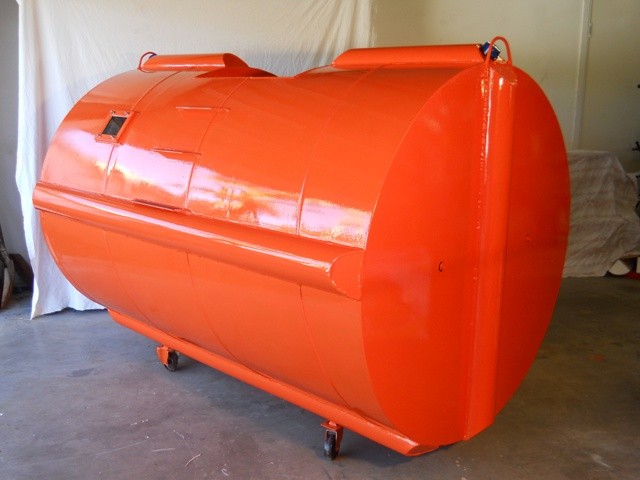
I researched into more recent design for tsunami survival ('Noahs Arc' was designed in 2011) and discovered a more recent design by an Australian houseboat builder, Matt Duncan, who designed a tsunami pod after being stunned by the footage of the earthquake and tsunami disaster in Japan which he saw on television. 

The pod is made from 4mm spiral welded steel, has a crush capacity of four tonnes, and features impact-absorbing crumple zones. It accommodates four people in five-point harnessed safety seats, and can reportedly hold enough air to last those passengers for two and a half hours. It has a main hatch and a bottom-mounted secondary hatch (in case it ends up upside-down), both of which open inward to avoid being blocked by external debris. Each of those hatches also feature a one-inch-thick window, to help minimise claustrophobia.

Matt and his tsunami pod

Inside of pod: seats with seat belts and a window


The pod has a streamlined design, to keep it from getting snagged on debris or other objects. Should it avoid all the snags and end up getting washed out to sea, its flashing exterior lights ought to help attract rescuers. Once they find it, its integrated lifting hooks should help it be hoisted by a helicopter or ship-mounted crane.

Four small wheels on the bottom allow it to be pushed around by hand on smooth surfaces (such as driveways), and it’s said to be small enough to fit in a typical garage or carport. It would definitely be worth investing in if it makes the difference between life or death on the off chance that you'll experience a tsunami, and it can also be used as an earthquake shelter.

Pod design showing wheels


To promote the pod, it should be advertised online as sponsored featured ad on search engines when people search tags search as 'earthquake' 'disaster' 'tsunami'.

There should also featured video on Youtube of the device, it's functions, and a demo of it being tested, to appear when people search and view videos of natural disasters. 

It would be tactful for the pod to be advertised on television, especially on national weather reports when warnings are being sent out when particular areas are at high risk.

They could even be sponsored ads on social media sites such as Facebook for citizens profiles living in the high risk area's. Facebook sponsored ads allow you to specify the location of your intended target audience so the ad is more effectively placed.

The pod needs to be promoted, advertised and discussed through all types of media and social media platforms, for example magazines, newspapers, blogs and twitter. It should particularly be pushed in the high risk areas of America and Asia. The more people who know about it, the more it will be spread by word of mouth too.


Below is a link to a video demonstrating news coverage of the invention.


Tuesday, 4 September 2012

Invisible Helt


Two Swedish women set out to invent “the invisible bicycle helmet” and succeeded by creating 'Hövding'.

Hövding is a collar for bicyclists, worn around the neck. The collar contains a folded up airbag that you'll only see if you happen to have an accident. The airbag is shaped like a hood, surrounding and protecting the bicyclist's head. The trigger mechanism is controlled by sensors which pick up the abnormal movements of a bicyclist in an accident.
The actual collar is the visible part of the invention. It's covered by a removable shell that you can change to match your outfit, and we'll be launching new designs all the time. Hövding is a practical accessory that's easy to carry around, it's got a great-looking yet subtle design, and it will save your life.

Hövding being worn around the neck

It uses rechargeable battery-powered accelerometers and gyroscopes to detect movement that resembles being in a bike crash and launches airbags around the wearer’s head. Weighing 1.5 lbs. without the shell, the airbags are powered by a cold helium inflator located in a holder in the collar. Though similar to motorcycle helmets with inflators, this helmet is only for bicycles — not skateboards, mopeds, or skates, either. The helmet also contains a “black box” that records 10 seconds of data of the cyclists’ movement before an accident.

Airbag of Hövding

The helmet costs around $600, which is an expensive safety measure. But considering the potential hospital bills and the risk of death, it might be a good investment for fashion-forward bikers.  The helmet is only good for one use, so it has to be replaced after it deploys.


Every year about 40 people die and about 30,000 are injured in bicycling accidents, and that's just in Sweden. One in three bicyclists who are injured suffer head injuries. The most effective protection against serious injuries to the skull is to wear a bicycle helmet every time you get on your bicycle. International studies show that bicycle helmets reduce injuries by at least 60%. 40% of people who die in bicycling accidents would have survived if they had been wearing a helmet.
Despite these alarming accident statistics, the vast majority of cyclists on the roads aren't wearing helmets. This is partly because bicycle helmets are bulky and impractical to carry around when you're not on your bicycle, but it's also because people think bicycle helmets look hideous and make them look silly.

More and more countries are introducing legislation to make bicycle helmets compulsory. In these countries bicycle helmet use is quite widespread, although it is still not compulsory in Britain where bicycling is a very popular means of transport. However, bicycle helmets are far from popular, to put it mildly.
There are several reasons why lots of people are choosing not to wear bicycle helmets at the moment. The traditional polystyrene helmets take up a lot of room, are hard to carry around and you can't lock them to your bicycle securely. They ruin your hair and you can't get a hat on underneath.

The range of bicycle helmets available is extremely narrow, they all look the same and the lack of variety results in very few people wearing them. For most people, bicycling isn't a sport. They're just using their bicycles to get from A to B, bicycling to work, into town or to go out in the evening. Despite this, almost all the traditional bicycle helmets on the global market have a sporty design. At the same time, image is becoming increasingly important to us and our clothes and accessories are an essential part of the way we express ourselves. Lots of people are deciding not to wear bicycle helmets because they think they look horrible and because they really don't go with their own personal style. The fact that people are choosing not to wear bicycle helmets when we all know how important the protection they provide is, was a clear sign that their design needed a radical makeover, adapting it to the demands of today's bicyclists and all their latest styles. A helmet that just sits on the shelf is no good to anyone.

Another main cause of accidents is bicycling when intoxicated. In Britain binge drinking is very common, especially amongst teenagers and students. People are less likely to think or care about wearing a helmet when drunk too. Helmets are fairly heavy so it is an inconvenience to have to wear one to or from somewhere as in between it has to be carried around.

I think this design would be very useful in countries and societies where cycling is common and cyclists are image and fashion conscious. The two places which spring to mind are Britain and China.
If brands were to collaborate with Hövding it would increase the awareness of the product for Hövding, make it 'cooler' to wear, and increase bicycle safety in general. The design is very easy to adapt, pattern wise.
Patterned Hövding


To promote this design the Government could create awareness campaigns about teenage bike accidents. 
Peterborough Evening Telegraph reporters photographed  sixteen  young cyclists riding without a helmet over a one hour period. The paper also featured photographs of a nine-year-old cyclist who was nearly killed on the 1st of July. The youngster was hit by a car and was not wearing his helmet. He suffered from serious head injury and broken bones. The boy’s family felt that  pictures of their son’s bike crash might encourage youngsters to think about their own safety.
These awareness campaigns could be shock tactic adverts on television, and they could show someone wearing variations of safety equipment, helmets and Hövding.
If collaborated with high fashion brands, the campaign photographs could be featured in fashion magazines such as Vogue and the fashion brands could hold fashion catwalk events.
Media coverage on Hövding would be useful too, coverage through the news, newspapers, articles in magazines etc.
The demonstration video could be pushed as a featured video on youtube too to encourage blogging and viewing.
Hövding could also branch out to promote via social media platforms: blogs, Twitter and Facebook.
They could also hold guerilla events in China and Britian.


Saturday, 1 September 2012

$9 Cardboard Bike


Izhar Gafni, an inventor from Israel, has developed a bicycle made of cardboard, costing just £10 to make. Izhar Gafni has created a fully functioning, water-resistant bicycle, made, from seat to spokes, entirely of recycled cardboard. The technology makes the environmentalist's choice mode of transportation even a bit greener and affordable.


Carboard bike

The all cardboard bike is suprisingly durable: it can carry riders who weigh up to 485 pounds. A layer of coating atop the cardboard shields the bike from the elements and gives the finished product the look and feel of lightweight plastic. While the cost to make the bicycle ranges from nine to twelve dollars, the manufacturer expects to sell the vehicle for sixty to ninety dollars depending on the optional addition of an electric motor.


By folding over sheets to double their strength, he claims the machine is durable, waterproof and costs very little to produce. Everything apart from the brakes and chain is cardboard - including the seat. It comes with the option of an electric motor and a smaller child’s version weighing 3.5 kilos and with a production price of £5 is also in the pipeline.

Being so cheap to produce, yet so effective as a form of transport, this design could make a real impact on the lives of children living in third world countries, such as Africa and parts of Asia, who walk dozens of miles a day for school or to collect water and food for their families. It would provide them with a fast means of transport and provide them with a much higher quality of life.

To promote this item, I feel charities should fund mass production of these bikes and distribute them to third world countries through Government funding and  public and business sponsorship. The charities could promote the cause and campaign through campaigns on the television which cause the target audience to feel empathetic and guilty, and promote online and on the streets to the public.
They could also encourage children in schools to take part in sponsored events to raise money and awareness.

Friday, 31 August 2012

Plastic Bag and Disposable Foam Product Ban in Haiti


Miami Herald reports that as of October 1st the importation, manufacture or sale of plastic bags and disposable foam products will be banned in Haiti. Most such products are currently imported from the Dominican Republic.


Prime Minister Laurent Lamothe says the ban is aimed at attempting to address the nation's massive litter problem and protecting the nation's coastline, shore and remaining mangrove forests.
In built up areas Lamothe says non-biodegradable waste clogs "95 percent of our sewage system, creating mass floods in poor neighborhoods...that is costing the state more than $50 million a year, if we had the means to clean up."
Lamothe also notes that advantages of switching (returning...) to non-plastic biodegradable alternatives "will benefit Haiti's short, mid and long-term environmental interest."

Two main concerns are that unless there are readily available alternatives and there is consistent enforcement of the ban, it will be ineffective and may well end up hurting some of the people most directly affected by the litter problem when sewer systems back up.
The second concern is banning plastic and foam products has to be just the first step. In a situation where plastic pollution is to pervasive (as it is in Haiti and in many poor nations or neighbourhoods where trash collection is non-existent) that trash then has to be cleaned up. Even if the source of pollution is removed, the existing pollution doesn't go away. Meaning, that $50 million/year price tag the Prime Minister mentioned still stands—although it may not be increasing anymore.

The two areas of concern are issues in Haiti. However developed westernised countries and societies where waste is of abundance could really benefit from such a ban. There are high levels of waste, especially in Britain and parts of America and China.
Realistically, I could see this law being implemented and working most successfully in Britain. In Britain there is a high turnover use of plastic bags and disposable foam products. Britain have readily available alternatives which could quickly be implemented and the second concern being trash being cleaned up is also not an issue. The council successful remove waste from all house holds regularly and consistently.
By implementing this law, waste levels will be lowered which means over it will reduce levels of carbon monoxide and pollution, reducing the effects of globalisation.

To sum up, this ban could be applied to Britain through applying new Government laws banning the importation, manufacture or sale of plastic bags and disposable foam products.


Thursday, 30 August 2012

Earthquake-proof Table


Israeli industrial designers, Arthur Brutter and Ido Bruno, have designed the "Earthquake-Proof Table" was built with the table’s live-saving potential in mind. "Existing non-earthquake-designated classroom tables often turn into lethal traps for those taking refuge."


A common tip for surviving an earthquake, told to everyone from school kids in Los Angeles to salarymen in Tokyo, is simple: when you feel the ground shake, get under the nearest table or desk to protect your head from broken glass, flying debris, or falling ceiling fans. But the reality is, most tables aren’t that strong, and in developing countries where cheaply built schools are likely to crumble, getting under a table won’t do much anyway.

The designers believe the table could provide safety to the 300 million students worldwide living in countries prone to quakes. It’s light enough for students to move, but can withstand more than 2,000 pounds of impact.

While researching the design, the team interviewed school directors and emergency responders around the world, including personnel who participated in rescue efforts after recent mega-quakes in Turkey and Haiti. The goal was to figure out an affordable way to mass produce the table without sacrificing safety. Their research shows that furnishing a classroom with these tables would be 10 times cheaper than strengthening the walls and 500 times cheaper than rebuilding a class or school to earthquake safety standards. Ido and Brutter, who collaborated on the project at Jersualem's Academy of Arts and Design, are now in talks with various governments and UN agencies to figure out how to bring the new technology to the places that need it.

To sum up, furnishing classrooms with these tables in parts of the world which are at a high risk of earthquakes could prove 10 times cheaper than strengthening the walls and 500 times cheaper than rebuilding a class or school to earthquake safety standards. They are also affordable for the less developed high risk countries as they are cheap to produce.

To promote and encourage use of the tables in classrooms, the designers should persuasively pitch the benefits to various governments and UN agencies.
To stress the benefits they should show a demo of the model in a stimulated earthquake and stress how much money and potential lives could be saved, using direct comparisons to the current set up in classrooms.
Charities could also raise funds through sponsorships and campaigns online, actively on the streets and through advertising on television to fund manufacturing and provide the less developed countries with these for their schools.


Tuesday, 28 August 2012

Financial Literacy to Help the Poor Escape Poverty


Money management is a critical life skill and those without such skills are often forced into a downward cycle of poverty and missed financial opportunity, unless fortunate enough to be born into a wealthy family. Even minor setbacks can be devastating. The impoverished in developing countries are at an even greater disadvantage due to the general lack of financial education, fewer resources, and challenging socio-economic conditions.  Financial literacy education is a powerful tool that has the potential to help the poor escape poverty by building savings, growing assets, and creating wealth. 

Saving money may seem straightforward, however many at the base of the economic pyramid (BOP) are barely able to do so. What little money they do have is kept on their person or hidden within their household. Saving even a pound or two per week can cultivate much needed savings habits. Core concepts such as saving money are the basic foundation for proactive financial planning. These practices will not only help consumers build savings, but will further develop good money management habits enabling BOP consumers the rare opportunity to plan for their future.

Some, however, have raised concerns about the effectiveness of financial-literacy education. Law Professor Lauren E. Willis of Loyola Law School published a journal titled ‘Against Financial-Literacy Education’ in November 2008, citing the lack of empirical support of the effectiveness of financial-literacy education. Prof. Willis cites in her report that the hours of study needed in order to obtain financial literacy is beyond the reach of most people, citing as an example the complexities involved in evaluating a retirement plan. I agree; this would indeed be a cumbersome task for the non-expert. This does not mean, however, that ordinary consumers would not benefit with some form of basic financial literacy education. 

Not only do the beneficiaries of financial literacy education stand to prosper. There are opportunities buried in untapped markets for banks and financial service providers to offer the same basic services available to those in rich countries, however, designed for BOP markets. Financial service providers serving BOP markets are rewarded with profitable sources of income by tapping into these millions of potential clients, many who are using innovative means to establish micro-businesses in order to escape the poverty trap. 

Technology is key. Online financial planning is a new and innovative way to provide financial planning to consumers who typically do not have access to professional advice. According to the Wall Street Journal, it is estimated that nearly 50 million U.S. based consumers that could potentially benefit from professional financial advice lack access to these services. Imagine the need for these services, even in their most basic form, in developing nations. Technology-based solutions have the potential to make a connection with the rural poor, such as cell phone banking. Banks do not find it profitable to establish branches in regions where the remote poor live. Cell phone bank accounts facilitate ease of deposits, thus avoiding long journeys to deliver cash, the need to conceal money within one’s household, or to incur expensive wire transfer charges. 

Another possible innovation may lie in the creation of social investment strategies designed specifically for consumers typically denied access to financial markets, giving them the opportunity to grow wealth in capital markets. Friends, family, and neighbors in BOP communities often pool their resources together. Fund managers and investment advisors may consider the possible rewards that lie in providing these consumers the opportunity to invest pooled funds, with continued contributions even in the smallest of increments, into low-fee micro-investing index funds. 

Universities are an ideal source of both initiative funding and financial expertise. Like-minded social entrepreneurs can form student and professional organisations enabling students, alumni, and academics to work collectively toward providing financial literacy education to the local community. These initiatives can be a terrific source of uniting low-income families together with financial services providers who may better understand and meet their actual needs. When these consumers become financially literate, they are more likely to better manage their money, and thus avoiding predatory bank revenue generating schemes. 

Many at the top of the economic pyramid have the willingness to explore new and innovative ways to promote financial literacy education. Similarly many at the bottom are actively involved in fighting their way out of poverty. Collectively we have the potential to grant the poor access to the basic building blocks of financial independence. 

Progress is being made toward financial literacy education. Organisations such as the Institute for Financial Literacy (IFL) aim to promote effective financial literacy education in the United States. Similarly, the Consumer Financial Education Body in the United Kingdom aims to help consumers understand financial services and to help them better manage their finances. Meanwhile the Organisation for Economic Co-operation and Development and the Reserve Bank of India have co-sponsored a financial literacy workshop in Bangalore India with a focus on the implementation of a national financial literacy program. 

For those who are interested in making a difference, The Institute for Financial Literacy (IFL) offers volunteer opportunities as Volunteer Educator or Outreach Volunteers. Those who serve as Volunteer Educators provide financial literacy education in their local communities. Outreach Volunteers are responsible for developing community based networks, holding financial-literacy discussions, and writing letters to newspapers or journals in support of financial-literacy education. The Center for Financial Certifications, an independent division of the IFL, offers professional certifications in credit counseling, financial education, and debt management, among others. 

Socckit


Soccket, is a plug-in soccer ball that captures the energy during game play to charge LEDs and batteries. The ball uses an inductive coil mechanism to generate energy.  After playing with the ball, the child can return home and use the ball to connect a LED lamp to read, study, or illuminate the home. 

Soccket Ball

The clever invention is made from materials found in developing countries and costs only slightly more than a normal high end ball to produce.

Soccket was an engineering class assignment at Harvard University, where co-founders Jessica Lin, Jessica Matthews, Julia Silverman, and Hemali Thakkar quickly bonded over their shared experiences in Africa and other developing countries to create an ingeniously simple portable generator.

The movement of the ball forces a magnet through a coil that induces a voltage to generate electricity and the coil doesn’t affect the motion of the ball. The beauty of soccket is that a kid in a developing nation can play a game of soccer after school, leave the playground, take the ball home, plug a basic lamp into a built-in fixture and have enough light to do homework.
For every 15 minutes played on the first version of sOccket, the ball was able to store enough energy to illuminate a small LED light for three hours. sOccket 2.0 has improved that ratio. Now, less than 10 minutes of play yields three hours of energy.


The ball, which has been trialled in South Africa, is waterproof, durable and doesn't need to be inflated. It uses inductive coil technology which involves having a metal coil and magnetic slug that goes forwards and backwards.

The use of kerosene to light people homes has serious health risks for 1.5 billion people worldwide. Kerosene not only is expensive, but the smoke poses serious health risks and its flames are very dangerous. The World Bank estimates that breathing the fumes created from burning kerosene indoors equals the harmful effects of smoking two packs of cigarettes a day.

More than 270 million people play soccer worldwide, including 46 million Africans, according to a 2006 FIFA study. In most African countries, 95 % of the population lives without access to electricity, according to a 2006 World Bank Millennium Goals Report. 

The special ball can currently be used with an ac adaptor but the designers hope this will be expanded in the future to enable other products to be charged by it.

Mass production and distribution of these balls in countries without access to electricity, such as most in Africa, could save thousands from the serious health risks bought on through the use of kerosene and can help bring people together through sport and play.

Mitti Cool

The Pot-in-pot Cooler, based on by ancient techniques, was designed by Mohammed Bah Abba who won the Rolex prize and who has been promoting this process though-out Nigeria. The concept takes advantage of evaporative cooling.

Pot-in-pot Cooler
The system works by fitting a lidded earthenware pot inside a larger pot with the space in between, filled with sand and water. The sand layer can be kept cool by adding water generally twice a day, thus providing refrigerated storage space at minimal cost.

When that water evaporates, it pulls heat from the interior of the smaller pot, in which vegetables and fruits can be kept. As water in the sand evaporates through the surface of the outer pot, it carries heat, drawing it away from the inner core, thus cooling the inside of the inner pot.
The Clay refrigerator enables tomatoes to last for twenty-one days, rather than two or three days–without this technology. It has proved very efficient and it has been tested with a number of different vegetables.

The same principle was applied by Mansukhbhai Raghavbhai Prajapati, a potter from Wankaner in Gujarat. He designed a fridge for the common man that does not require electricity and keeps food fresh too. With this basic premise in mind Mansukhbhai came up with Mitticool, a fridge made of clay. It works on the principle of evaporation. Water from the upper chambers drips down the side, taking heat from the inside gets evaporated, leaving the chambers cool. Cool and affordable, this is the option to keep food, vegetables and even milk fresh naturally for days.

Mitti Cool Fridge

Prajapati has come up with an innovative apparatus that functions like a refrigerator: It cools drinking water and can store vegetables for days on end without electricity. Made of clay, the 'fridge' has a 10-litre water tank at the top while the lower part has a chamber which can be used to store vegetables or other eatables that need cooling. His innovation is being supported by NIF and GIAN. 

After more than three years of continuous efforts and failures, in 2004 Prajapati's clay fridge model worked successfully. He called his product 'Mitticool.' The device works on the principle of evaporation. As the water evaporates through the pores of the clay, it not only cools the water itself, but also the lower chamber and its contents too.

Food preservation is one of the biggest problems in the rural areas, where farmers lack water, electricity and transportation. The harsh climates in several countries make it impossible for farmers to preserve their crops for more than three days. Beyond what they may eat and trade in their communities, the time works against them and they are losing the opportunity to sell the harvest at the market, hence missing an important source of income. Sometimes the market is located several miles away from their villages.

This is a very good alternative for the rural people who can not afford the conventional refrigerator due to high initial cost and its maintenance cost. Educating to less developed countries how to create Mitti Cools and Pot-in-Pot coolers should be encouraged to clay makers in rural areas so that these people are aware of this design and can use and benefit from it too. Examples of some of these regions are Nigeria and India.


Infant Warmer

Embrace has developed an innovative, low cost infant warmer for vulnerable babies. The design looks like a miniature sleeping bag that incorporates a phase change material, which stays at a constant temperature for up to 6 hours. This low-cost solution maintains premature and low birth weight babies' body temperature to help them survive and thrive.


The AccuTemp Heater warms the WarmPak to 98.6F, a temperature critical to a child’s survival. This version of the product requires access to an AC power source. However, it can also be run off of a generator or any alternate AC power source.  
The WarmPak absorbs heat from the AccuTemp Heater, and slowly releases this heat over a period of time to the newborn, when placed in the BabyWrap. No electricity comes in contact with the baby.

The BabyWrap traps the heat from the WarmPak and provides a warm, insulating microclimate to the newborn. The BabyWrap has been engineered to minimize heat loss from the WarmPak to the surroundings, thus ensuring that the WarmPak stays effective for a long time.


This design could save thousands of lives of vulnerable babies in developing countries. Over 20 million low-birth-weight and premature babies are born every year around the world, and over 4 million die within their first month of life. Temperature regulation is a key problem among many of these infants.  Embrace has developed an infant warmer that costs a fraction of the price of existing solutions, and that functions without a continuous supply of electricity.

By providing a low-cost and appropriately-designed alternative to traditional incubators, costs to the health-care system will be reduced. Also by providing affordable and accessible solutions to prevent hypothermia, these Infant Warmers will impact the lives of babies all over the world.

To promote this scheme, Embrace should donate their Infant Warmers to populations in need such as Somalia and India. To do so they could raise funding from campaigns and sponsorships or establish partnerships with NGO's who are serving the target markets.

They could also provide free training and education programs to address the root causes of low birth weight and other maternal/child health issues to raise awareness of the program and hopefully encourage sponsorship.